A farm’s water needs do not always match the local power supply. A field may need irrigation far from a grid connection, while livestock still need clean water on hot afternoons. Solar water pumps can move water from a borehole, pond, or canal using electricity generated by photovoltaic panels. In practical terms, that can mean fewer fuel deliveries and less dependence on a generator. Quiet operation is another benefit. You may hear little beyond the pump and the wind.
Why solar water pumps are ideal for agriculture depends on the farm, not just the technology. A well-sized system can support drip lines, storage tanks, or livestock troughs, but it must match the water source, pumping depth, daily demand, and available sunlight. A pump that looks adequate on paper may disappoint during cloudy weeks or peak irrigation season. That matters. Farmers should check seasonal water levels and pump specifications, and consider whether a storage tank or backup supply is needed. Solar equipment also needs installation, cleaning, and occasional repairs; it is not maintenance-free. Panel dust, shade, and a poorly chosen pump can reduce output. This article explores where solar pumping fits, how it can reduce operating costs, and what to assess before investing. The benefits are real, but they are not automatic. A careful site assessment helps turn sunlight into a dependable part of farm water planning.
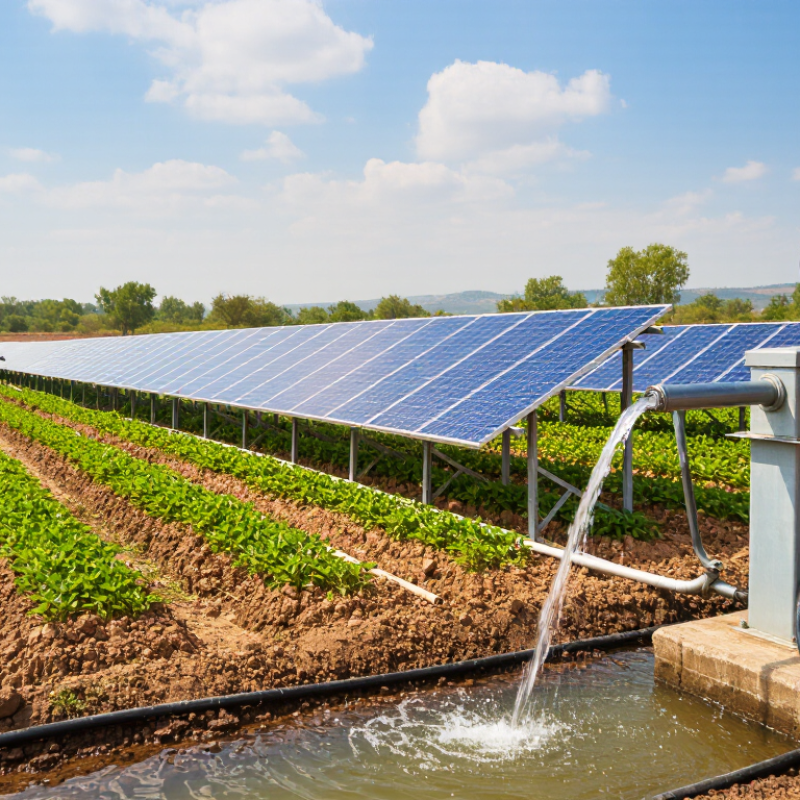
Photovoltaic panels convert sunlight into direct-current electricity. A controller adjusts power as sunlight changes and helps protect the pump motor. Some systems use an inverter to run an alternating-current motor. The motor turns the pump, lifting water from a well or other source into a tank, storage pond, or irrigation line. The chain is simple. But cloudy afternoons still matter.
FAO reports that agriculture accounts for about 70% of global freshwater withdrawals (Water for Sustainable Food and Agriculture, 2017). Solar pumping can reduce reliance on grid power or fuel, especially where sunlight is plentiful. IRENA reported that the global weighted-average cost of electricity from utility-scale solar PV fell 90% between 2010 and 2023 (Renewable Power Generation Costs in 2023, 2024). That trend supports wider solar use, though it does not guarantee a low-cost pump for every farm. Panel output, well depth, pump sizing, and maintenance all affect performance. Field conditions are rarely as tidy as a design sheet suggests.
Tips: Match pump capacity to the water source and daily irrigation need. Store water in a tank when sunshine is strongest, then irrigate later. Check water levels regularly; easy pumping can still drain a source faster than it recovers.
In an agricultural solar pumping system, each component has a distinct job. Solar panels convert sunlight into electricity, while mounting frames keep them angled and secure above dusty fields. Output changes with cloud cover, season, and panel temperature. The controller matches available power to the pump and can protect it from dry running or voltage problems. The pump lifts water from a well, pond, or tank. Its type and size should match the water source, required flow, and total lift height. Guessing here can waste water and money.
Pipes carry water to storage tanks, field channels, or drip lines. Correctly sized pipes limit pressure loss. A filter catches sand and debris before they clog emitters, though it needs regular cleaning. A float switch can stop pumping when a tank is full, while a low-water sensor helps prevent a well from being drawn down too far. Batteries are optional; pumping into a tank during daylight can avoid their cost and maintenance. A setup may look neat on paper but still perform poorly when the water source drops during a dry season.
Tips: Check flow during peak demand, not just on a cool morning. Keep panels clear of dust, inspect connections, and record weekly output. Small records help reveal trouble early. More panels will not fix a mismatched pump.
Solar water pumps serve more than crop irrigation. Farms use them to lift water from wells, ponds, and canals into storage tanks or distribution pipes. FAO’s AQUASTAT database estimates that agriculture accounts for about 72% of global freshwater withdrawals. That figure makes careful, targeted water delivery important, especially where farms depend on seasonal rainfall.
In crop production, pumps can feed drip lines for orchards, vegetables, and greenhouses, or supply sprinklers for larger fields. A tank filled during sunny hours can provide water later, when crops need it. IRENA’s report, Solar Pumping for Irrigation: Improving Livelihoods and Sustainability, discusses solar pumping as an option for irrigation where grid access is limited. The practical setup still depends on well depth, flow rate, and daily crop demand. A pump that is too small may leave plants thirsty during hot spells.
Livestock operations use solar pumps to fill troughs in remote pastures, reducing long walks to water points. Farms also use pumped water for washing equipment and cleaning produce areas, where local water-quality rules allow. There is a trade-off. Solar output changes with clouds and season, while animals and crops need steady supply. Storage helps, but it adds cost and needs maintenance. A shaded panel or clogged filter can quietly reduce performance.
Solar irrigation can deliver water at the field edge while reducing dependence on diesel and grid access. That matters. FAO’s AQUASTAT database estimates agriculture accounts for about 70% of global freshwater withdrawals. IRENA’s Renewable Power Generation Costs in 2023 reports that utility-scale solar PV’s levelized cost fell 90% between 2010 and 2023. These figures do not guarantee savings on every farm. Pump sizing, water depth, storage, and maintenance still determine system performance.
For growers, daytime pumping can align irrigation schedules with solar production, especially when crops need frequent, measured watering. A tank can store water for evening use, avoiding batteries in some installations. In remote fields, fewer fuel runs can mean less downtime during busy planting weeks. Drip lines or low-pressure sprinklers can direct water toward crop roots instead of bare soil. But not everywhere. Cloudy periods, deep wells, and seasonal water shortages may require backup power or tighter scheduling. A poorly planned pump can also encourage over-pumping when water seems inexpensive. Farmers should check seasonal well yield, crop demand, and local service access before choosing a system. Measuring water output and pump hours through the dry season is a practical step, though it is easy to neglect.
| Dimension | Solar-Powered Pump Characteristic | Potential Agricultural Advantage | Practical Consideration |
|---|---|---|---|
| Energy source | Photovoltaic panels convert sunlight into electricity to run the pump. | Can provide water in locations where grid electricity is unavailable or unreliable. | Output varies with sunlight, season, shading, and panel orientation. |
| Fuel use during operation | The pump can operate without consuming diesel or petrol while solar power is available. | Reduces dependence on fuel deliveries and avoids on-site fuel storage for pumping. | Backup power or water storage may be needed when pumping must continue after sunset or during prolonged cloudy periods. |
| Operating emissions | Solar panels generate electricity without combustion at the point of use. | Can reduce direct air pollutants and greenhouse-gas emissions compared with a fuel-powered pump. | Panels and other equipment still have manufacturing, transport, and end-of-life impacts. |
| Operating costs | Sunlight has no fuel purchase cost, although the system requires an initial investment. | May lower recurring energy expenses, particularly where fuel or grid power is costly. | Total cost depends on pump size, water source, installation, maintenance, financing, and local energy prices. |
| Water delivery timing | Pumping is generally strongest when solar energy is abundant. | Water can be pumped during the day and stored for later irrigation in a suitably sized tank or reservoir. | Storage adds cost and must be designed to match crop water needs and the available pumping capacity. |
| System sizing | Required pump capacity depends on flow rate, total pumping head, and available solar power. | Correct sizing helps deliver the water volume and pressure needed for the farm’s irrigation plan. | Assess the water source, elevation, pipe losses, daily demand, and seasonal sunlight before installation. |
| Irrigation compatibility | Solar pumps can supply water to systems such as drip, sprinkler, or surface irrigation when designed for their pressure and flow requirements. | Can support irrigation in remote fields and can be paired with efficient water-delivery methods. | A pump alone does not make irrigation water-efficient; system design, scheduling, and maintenance also matter. |
| Maintenance | Solar pumping systems have no fuel engine, but the pump and electrical components still require care. | In suitable installations, fewer fuel-related servicing tasks can simplify routine operation. | Keep panels clean, inspect wiring and controls, and maintain the pump, filters, and pipes according to their specifications. |
| Best-fit conditions | Most suitable where there is good solar exposure, a dependable water source, and a pump that matches the required head and flow. | Can be a practical option for farms seeking off-grid water supply or reduced reliance on fuel. | Compare the system with grid or fuel-powered alternatives using local costs, water demand, and seasonal conditions. |
Planning note: Solar pump performance and cost-effectiveness are site-specific. A qualified assessment should account for seasonal water demand, solar resource, water-source yield, pumping head, and any required storage.
Selecting a solar water pump starts with the farm’s daily water demand, not the panel size. Estimate the volume needed for crops or livestock, then check the source’s dry-season yield. A shallow well and a deep borehole require different pump types. Measure twice.
Total pumping head matters just as much as water volume. It includes the vertical lift and pressure needed at the outlet, plus losses through long or narrow pipes. A pump chosen for flow alone may deliver far less water than expected. Pipe bends add friction, too. On a real farm, a few extra metres of head can change the system’s performance.
Sunlight varies with season, shade, and local weather, so output is rarely constant throughout the day. Match the pump and solar array to useful operating hours, and consider a storage tank to hold water for cloudy periods or evening use. Batteries are not always necessary. Water quality also matters: sand or silt can wear components and clog outlets. Keep records of flow at different times; early estimates can be wrong, and field measurements often reveal why.
Panels turn sunlight into electricity. A controller adjusts power, and a motor drives the pump. Water moves into a tank, pond, or irrigation line.
Pump output may drop as sunlight changes. Cloudy afternoons still matter. A storage tank can hold water pumped during brighter hours.
Common parts include panels, mounting frames, a controller, a pump, pipes, and a filter. Sensors or a float switch can help prevent dry running or tank overflow.
Match the pump to the water source, required flow, and total lift height. Guessing can waste money. A deep well may need a different setup from a shallow pond.
They can supply drip lines, sprinklers, livestock troughs, and storage tanks. They may also provide water for equipment cleaning where local water-quality rules allow.
No. Pumping into a tank during sunny hours can provide water later without batteries. Storage still costs money and needs maintenance.
Check water flow during peak demand, clean dust from panels, and inspect filters and connections. Keep weekly output records. Small records help.
Yes. Easy pumping does not mean a well or pond can recover quickly. Check water levels regularly, especially during dry seasons. A neat design can still miss changing field conditions.
Why solar water pumps are ideal for agriculture becomes clear when sunlight is converted into a dependable source of water for crops and livestock. Solar panels generate electricity to power a pump, while components such as controllers, pipes, and storage tanks help regulate and deliver water where it is needed. Depending on the farm’s layout and water source, the system can support irrigation, livestock watering, and other everyday operations.
Solar-powered irrigation can reduce reliance on grid electricity or fuel, help lower operating costs, and provide water access in remote areas. Its performance depends on factors including sunlight availability, water-source depth, required flow rate, pumping distance, and seasonal demand. Choosing a system that matches these conditions helps ensure a practical and reliable water supply for agricultural production.

GeoSyn Solar